Students don't need more polished answers.
They need deeper thought.
I'm Dean. Dean's List is where my public writing becomes private training: literature, close reading, mentorship, and application guidance, shaped by serious conversation and twelve years of teaching.
Not homework help. Not packaged admissions polish. A serious intellectual apprenticeship for anyone learning to read, write, and think at a higher level.
The application is not the point. The thinking is.
Most students come to me trying to sound impressive. They list achievements, stack experiences, and polish sentences until everything looks right but says nothing. I slow them down. I ask questions they haven't been asked before. And gradually, they stop performing and start thinking.
Part of the work is learning to see the student clearly. I pay close attention to what a student is good at, what they're drawn to, and where they have depth they haven't recognized yet. Then I help them build on it. Not package it for an application, but actually develop it. A student who discovers what they genuinely care about doesn't need to be coached on how to sound passionate. They just are.
Each student gets sustained, personal attention. There are no templates, no formulas, and no shortcuts.
Different ages. The same intellectual practice.
The same student, twelve months apart. What changes is not the vocabulary. It is the thinking underneath it.
“Steinbeck wants the reader to notice that George’s personality is a complete opposite with Lennie, George with a strong, healthy, almost mature vibe while in contrast Lennie’s personality is more of an unhealthy, immature feeling.”
Sharp instinct. He sees the contrast, but cannot yet explain why Steinbeck built it that way, or what it reveals about the novel’s deeper argument.
“The first signs of this corruption can be found in Chapter 1, when Old Major gives his famous speech. Orwell depicts him as a political visionary with the power and charisma to bring all the animals together. His speech is powerful because it simplifies the world into a clear moral struggle.”
He is no longer describing. He is tracing how language becomes a tool of power, and naming the mechanism behind it.
Why did Wilde choose to make the Prince a statue instead of a living king? What can a statue see that a living person cannot?
When people are living, they usually don’t help others because they are too busy living their own lives. The prince was too busy with his own happiness and overlooked other’s suffering. Only after he died, he starts looking at other people’s misery. This tells us that in reality, people don’t help each other when they are living. Only when they are about to die, they think “I should have helped others more.”
This is a real insight. You went past the plot and found the reason Wilde made him a statue in the first place: because being alive made him blind. You moved from what happens in the story to why Wilde built it that way, and that move is exactly what close reading is.
I keep thinking about the Swallow now. The Prince can see everything, but he cannot move, so nothing actually changes until the Swallow agrees to stay and do the work for him. Maybe Wilde is saying that seeing the problem is not the same as fixing it. The Prince needed someone willing to act, and the Swallow died doing it. So caring is not enough on its own. It needs someone who actually moves.
Using a Marxist lens, discuss how The Great Gatsby critiques class divisions, and to what extent it endorses them. Consider Nick’s claim that “fundamental decencies” are “parceled out unequally at birth.”
The soaring skyscrapers, the bustling streets, and the glittering lights of 1920s New York concealed a stark reality: a society constructed upon profound economic inequalities, where wealth determined status, privilege, and even morality. In The Great Gatsby, Fitzgerald critiques these class divisions through a Marxist lens, exposing the American Dream as an empty promise.
The three-item scenic opening (“soaring skyscrapers, bustling streets, glittering lights”) is the kind of throat-clearing AP graders read hundreds of times a day. It delays your argument. What makes this essay yours is not restating the lens you were given. It is what you see through it that isn’t obvious. Start with the text. Start with what’s strange.
I think I was blaming the wrong person. Gatsby breaks every rule about class and it destroys him, but Nick just watches and walks away fine. So the book is not only saying the rich are cruel. It is saying the system rewards the people who never fully believe in the dream and punishes the ones who do. Gatsby wanted in the most, and that want is exactly what ruined him.
Orwell complicates the idea of resistance by suggesting that the Party may manufacture rebellion rather than merely suppress it. Goldstein and the Brotherhood offer citizens an apparent alternative to Party rule, yet their existence is never independently verified. By presenting a controlled image of dissent, the Party gives the population a target for its anger while also attracting individuals who privately reject the regime. Winston and Julia’s trust in O’Brien therefore does not lead them toward liberation; instead, it exposes their thoughts and desires to the very authority they hope to escape. In this sense, the Party maintains power not only by punishing opposition, but by determining the form that opposition is allowed to take.
Student analytical writing · Orwell, Nineteen Eighty-Four
Shared with permission. Identifying details changed where appropriate.
The Allegory of the Classroom · move through the dark
Outside the cave
Who truly am I?
What shaped my thought?
How do I see the world?
What do I actually believe?
What have I never questioned?
What do I notice that others miss?
What students and families notice
“Before working with you, I would have just listed everything I’d done and hoped it sounded impressive. You showed me how to step back and actually think about what those experiences meant. That shift changed everything about how I wrote, and honestly, how I see myself.”Graduate applicant, Engineering Admitted to Stanford
“You’re not just teaching him. You’re mentoring him, opening his mind, helping him see the world differently. Before every session I can feel how excited he is. He always comes out with this energy, like he just discovered something new. He told me every class feels like an adventure.”Parent of a middle school student
“When I saw what you did with my draft, I finally understood what strong writing looks like. Clear, focused, driven by ideas instead of jargon. Working with you didn’t just improve my essay. It gave me a model for how to think and write going forward.”Graduate applicant, Pre-Med / Biology Admitted to Oxford, UC Berkeley, and Emory
“When she first started working with you, she didn’t even want to think about boarding school. Now she writes with a confidence I’ve never seen from her. She found her voice, and I know that’s because of what you built together.”Parent of a middle school student Accepted to Choate Rosemary Hall
I don’t know how to say this without getting emotional.
Thank you for everything you’ve done for .
He wants to keep working with you even after he starts university. He says the conversations you have together are the most meaningful part of his week.
We are so grateful 🙏
A parent’s message after her son’s admission to UC Berkeley and UCLA
I’m so thankful for everything. Without you I would have just listed all my activities and achievements like everyone else. You helped me actually understand what mattered to me and write about it in a way that felt real. I don’t think I would have gotten in otherwise.
A student’s message after admission to Stanford and UCLA (EECS)
Different students, the same depth
Foundations · Grades 4–8
The early years build the habits everything else depends on: how to read closely, how to notice what a writer is actually doing and why, and how to make a claim and defend it under pressure. We work through real literature, short stories first, then longer fiction, asking the same question every week for years: not “what is this story about?” but “what is the writer doing, and what would be lost if they made a different choice?” These are often my longest relationships.
Close reading, causality, evidence, paragraph construction, intellectual confidence.
Advanced reading and academic writing · Grades 9–college
As the reading grows more demanding, the work turns to ambiguity and competing interpretations: holding two readings at once, building an argument that survives pressure, and shaping it into prose that sounds like the student and no one else. This is where analytical voice and timed writing come together.
Ambiguity, competing interpretations, argument, structure, analytical voice, timed writing.
College and graduate applications
By this point the reading and thinking habits are usually already there. The work becomes selection and judgment: deciding what actually matters, choosing what belongs on the page, and answering the one question only this person can answer. The essay is not assembled. It is arrived at. I do not write essays for students, and I do not build them from templates.
Selection, judgment, personal narrative, deciding what belongs.
We do not read randomly.
We read to train perception, structure, and judgment. The sequence is organized by cognitive development, not popularity. Each tier builds on the last. The authors below are not a checklist; they show the kinds of texts used at each stage, chosen for a student’s readiness.
One place the work appears.
Two opening paragraphs from college application essays written by students I have worked with. Shared with permission; identifying details changed where appropriate.
My grandmother called it stubbornness. She said my younger cousin refused to speak Mandarin because he wanted to be difficult, because he was embarrassing the family on purpose. But I had watched him try. I had seen the way his jaw tightened before every sentence, the way he looked at me after each attempt as if asking whether it was safe to keep going. He was not refusing. He was afraid of getting it wrong in front of people who would remember.
That summer I started sitting with him after dinner, just the two of us. Not drilling. Not correcting. Just repeating things back to him until his voice stopped dropping at the end of every sentence. I did not realize, at the time, that I was learning something about teaching: that the first thing a student needs is not instruction. It is the belief that their effort will not be punished.
Admitted to Columbia, Brown, Cornell
The first thing I noticed was that nobody looked up. The restaurant was full, every table taken, and my father moved between them carrying plates that were heavier than I could lift. I stood by the register, too young to take orders and too old to sit in the back and watch cartoons. So I started folding napkins, into neat triangles, and placed them in a stack that grew taller than the register. No one asked me to. No one told me to stop.
I think about that version of myself more than I probably should. Not because the work was hard, but because it was the first time I understood that belonging is not something you are given. It is something you build, quietly, by finding the thing that needs doing and doing it before anyone notices it was missing.
Admitted to Yale, UCLA, UC Berkeley, Princeton, Northwestern
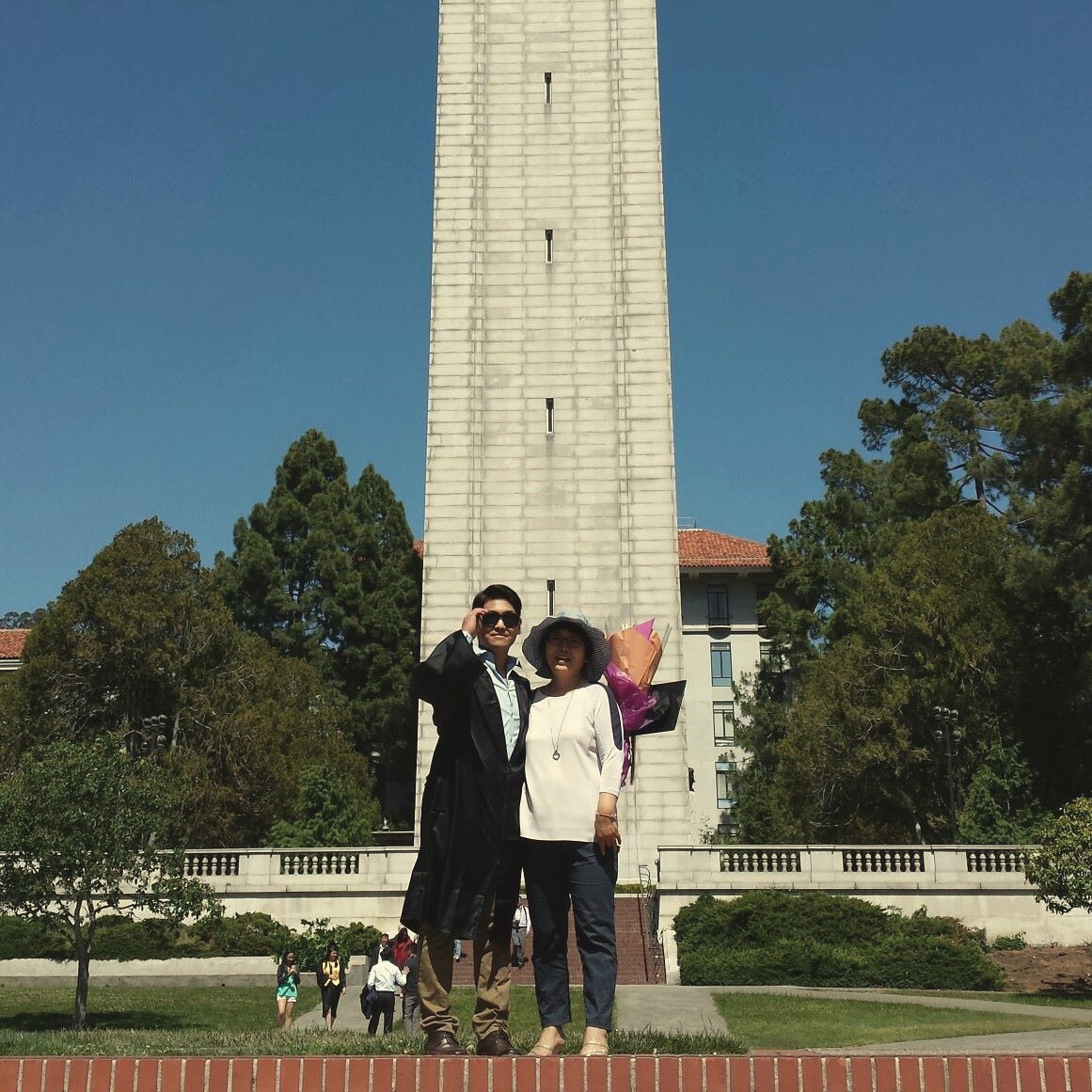
Dean
I graduated from UC Berkeley, where I studied Political Economy. I did not originally expect teaching to become my life’s work. What kept me was watching what happened when a student stopped trying to produce the correct answer and began noticing something for themselves.
Over the past twelve years, I have worked with students from elementary school through graduate applications. Some arrive weeks before a deadline. Others stay for years. The longer I do this, the more convinced I become that the most valuable thing an education can develop is not performance, but judgment: the ability to see clearly, decide what matters, and say it honestly.
See if this is a fit.
Tell me about the student and I will reply personally. I speak with families directly when the work is going well or needs to change.